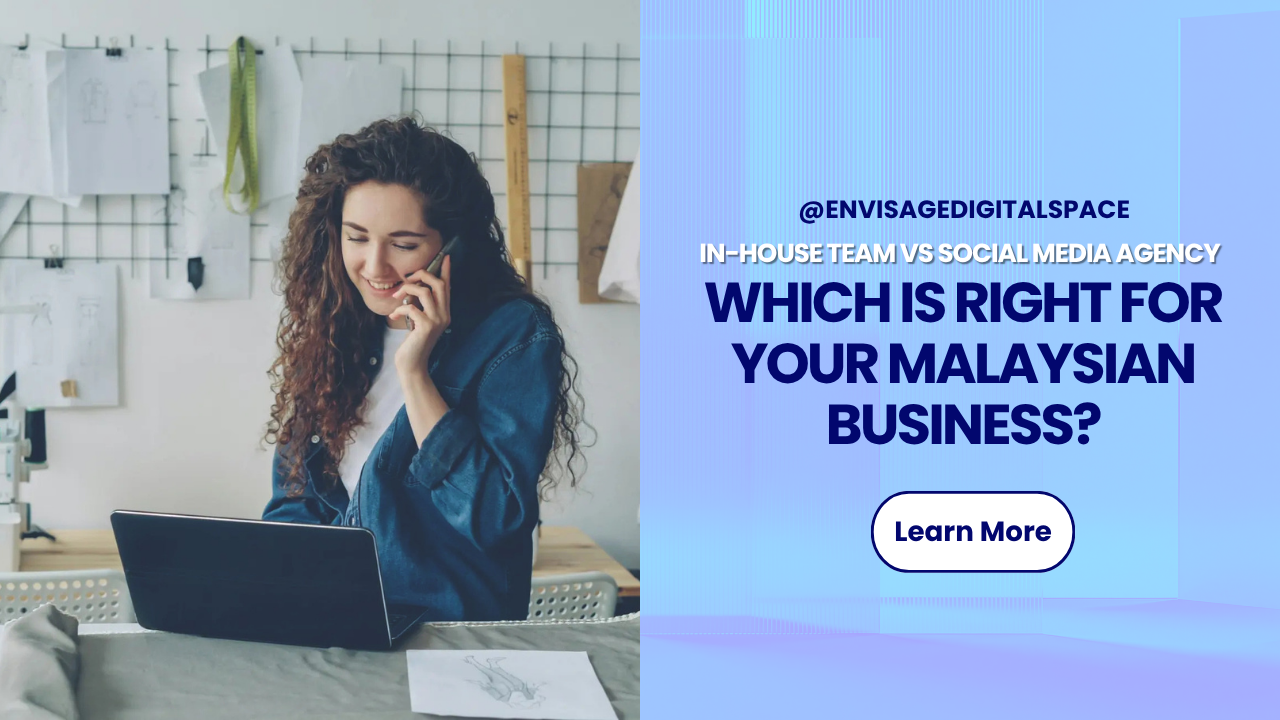
In-House Team vs Social Media Agency: Which Is Right for Your Malaysian Business?
Social media has become an essential part of business growth in Malaysia. From reaching new customers on Instagram and TikTok to building brand awareness on Facebook and Xiaohongshu, businesses increasingly rely on social media to attract audiences, strengthen customer relationships, and generate sales. However, as social media becomes more competitive, managing it effectively requires more than simply publishing posts and replying to comments.
One of the biggest decisions Malaysian businesses face is whether to build an in-house social media team or work with a professional Social Media Agency. Both approaches offer distinct advantages, but the right choice depends on a company’s budget, marketing objectives, internal capabilities, and long-term growth plans.
An in-house team provides greater direct control over daily activities, brand communication, and internal collaboration. A Social Media Agency, on the other hand, can offer access to specialised expertise, established workflows, creative resources, and experience managing campaigns across multiple platforms.
For Malaysian businesses, this decision also involves practical considerations such as hiring costs, local audience behaviour, language requirements, platform preferences, and the ability to keep up with rapidly changing social media trends.
Neither approach is automatically better for every business. A startup with limited resources may benefit from outsourcing its social media management, while an established company with complex communication needs may prefer an internal team. Some businesses may even achieve the best results through a hybrid model that combines both approaches.
This guide explores the differences between an in-house team and a Social Media Agency, including their costs, benefits, limitations, and suitability for different types of Malaysian businesses.
What Is an In-House Social Media Team?
An in-house social media team consists of employees who work directly for a business and manage its social media activities internally. Depending on the company’s size and resources, the team may include a social media manager, content creator, graphic designer, copywriter, videographer, community manager, and paid advertising specialist.
Smaller Malaysian businesses may begin with just one employee responsible for several marketing functions. Larger organisations may develop a dedicated department with separate employees overseeing content production, influencer partnerships, social media advertising, analytics, and community management.
The main advantage of an in-house team is its close connection to the business. Employees can communicate directly with other departments, access internal information, understand product details, and respond quickly to changes in business priorities.
For example, a Malaysian retail brand launching a new product can coordinate its social media content with inventory updates, promotional offers, customer service, and sales activities without relying entirely on an external provider.
An in-house team can also develop a deeper understanding of the brand’s personality, customers, internal processes, and long-term objectives over time.
However, building an effective team requires more than hiring someone who knows how to use Instagram or TikTok. Businesses need employees with the right combination of creative, strategic, analytical, and technical skills. They must also provide suitable tools, training, management, and resources to support consistent performance.
For businesses with limited budgets, hiring multiple specialists may be difficult. Even when a company employs a capable social media manager, that individual may not have the time or expertise to handle content production, paid advertising, influencer campaigns, and performance analysis equally well.
What Is a Social Media Agency?
A Social Media Agency is an external marketing service provider that helps businesses plan, manage, and improve their social media presence. Depending on the agency’s services, this may include social media strategy, content creation, graphic design, short-form video production, account management, community engagement, influencer marketing, paid advertising, and performance reporting.
Instead of hiring every specialist internally, a business can access a team of professionals through an external partnership.
For example, a Malaysian beauty brand may work with a Social Media Agency to develop its Instagram content strategy, produce TikTok videos, coordinate KOL campaigns, manage paid social advertising, and monitor campaign performance. These activities can be coordinated through one service provider rather than several separate hires.
A professional agency may also bring experience from working with businesses across different industries. This experience can help identify suitable content formats, campaign opportunities, audience behaviours, and marketing approaches that an individual company may not have encountered internally.
For Malaysian brands, a suitable Social Media Agency should also understand the local market. This includes the importance of culturally relevant content, multilingual communication where appropriate, festive marketing periods, and differences in audience behaviour across platforms.
However, outsourcing does not mean that a business can completely disengage from its social media strategy. The agency still needs accurate product information, clear brand guidelines, timely feedback, and an understanding of the company’s commercial objectives.
The quality of the partnership therefore depends on communication, expectations, strategic alignment, and the agency’s ability to deliver measurable value.
In-House Team vs Social Media Agency: What Are the Main Differences?
The most important difference between an in-house team and a Social Media Agency is how marketing resources are organised.
An in-house team operates as part of the business, while an agency provides external expertise and services through an agreed working relationship. This distinction affects cost structure, flexibility, creative resources, communication, and accountability.
An internal team generally offers more immediate access to company information and greater day-to-day control. Employees can participate in internal meetings, communicate directly with sales teams, and respond to changing business requirements without waiting for an external partner.
A Social Media Agency offers a different advantage: access to a wider range of skills without necessarily requiring the business to recruit every specialist. This can be particularly useful when campaigns involve multiple platforms, creative formats, paid advertising, and influencer collaborations.
The two models also differ in how easily businesses can scale their marketing activities. An in-house team may need additional recruitment when workloads increase, whereas an agency may be able to adjust its services according to an agreed scope and budget. However, agency capacity depends on its staffing, service package, and contractual arrangements.
Neither model guarantees better results on its own. A highly capable internal team may outperform an agency that lacks industry knowledge, while an experienced agency may deliver more comprehensive support than a small team stretched across too many responsibilities.
The right comparison should therefore consider the actual capabilities, costs, and outcomes each option can provide rather than assuming that one model is inherently superior.
Comparing the Costs of an In-House Team and a Social Media Agency in Malaysia
Cost is often one of the first considerations for Malaysian businesses deciding how to manage their social media marketing.
An in-house team involves employee-related expenses, including salaries, statutory employer contributions where applicable, recruitment, training, equipment, software subscriptions, and other employment costs. Businesses hiring multiple specialists must account for these expenses across the entire team.
For instance, a company may need a social media manager to oversee strategy, a designer to create visual content, and a videographer or editor to produce short-form videos. If paid advertising is also a priority, additional expertise may be necessary. The total cost can become substantial even before advertising spend is included.
A Social Media Agency typically charges through a monthly retainer, a defined service package, or a project-based arrangement. The cost depends on the services provided, content volume, number of platforms, campaign complexity, and level of strategic involvement.
Although agency fees can appear expensive when compared with the salary of a single employee, the comparison may be misleading. The agency’s fee could cover several types of expertise, creative production, reporting, and campaign management that would otherwise require separate resources.
However, businesses should not automatically assume that an agency is cheaper. A comprehensive agency engagement may cost more than a lean internal team, particularly if the business requires extensive video production, frequent campaigns, or specialised services.
Companies should also distinguish between management fees and advertising budgets. Money paid to a Social Media Agency for campaign management is not necessarily the same as the budget spent on advertising placements. Production expenses, creator fees, software costs, and other services may also be charged separately.
The most useful approach is to compare the total cost of ownership of both options over a realistic period. Malaysian businesses should evaluate what each model includes, how much internal supervision is required, and whether the available resources can deliver the desired marketing outcomes.
Which Option Offers Better Social Media Expertise?
Social media marketing involves several specialised disciplines. These include content strategy, copywriting, graphic design, video production, audience research, community management, paid advertising, analytics, and platform-specific optimisation.
An in-house team may possess strong knowledge of the company’s products and customers, but its overall expertise depends on the skills of the employees hired. A small team may need to prioritise certain activities while leaving other areas underdeveloped.
For example, a social media manager may be highly skilled at content planning but have limited experience with advertising optimisation or advanced video editing. If the business expects that person to handle every aspect of marketing, the quality of execution may suffer.
A Social Media Agency can provide access to different specialists within one working relationship. Depending on the agency, the business may receive strategic guidance from experienced marketers, creative input from designers, production support from video specialists, and campaign management from advertising professionals.
This can be particularly valuable for companies that want to expand into unfamiliar platforms or experiment with new content formats without immediately building an entirely new department.
However, businesses should assess the actual team assigned to their account rather than relying solely on an agency’s overall reputation. Not every agency offers every specialisation, and the depth of expertise can vary considerably.
The best choice is the one that provides the skills your business genuinely needs. If your marketing requirements are relatively simple and consistent, one capable internal employee may be sufficient. If your strategy requires multiple specialised functions, an agency may offer a more practical way to access those capabilities.
Creative Control and Brand Understanding
One of the strongest arguments for an in-house team is its direct relationship with the brand.
Employees work within the organisation and can become familiar with its products, company culture, customer expectations, and internal decision-making processes. This knowledge can help them produce content that accurately reflects the business and respond to changes without extensive onboarding.
In-house teams can also be particularly effective when social media content depends on frequent internal updates. Businesses in hospitality, retail, events, and other fast-moving industries may need to communicate operational changes, new products, or customer concerns quickly.
A Social Media Agency, meanwhile, must learn the brand’s identity, tone of voice, product information, approval procedures, and business objectives. During the initial stages, this may require additional briefings and feedback.
However, an external agency can also introduce fresh creative perspectives. Because it works with different brands and campaigns, it may identify opportunities that an internal team has overlooked or challenge established approaches that no longer resonate with the audience.
The key is to establish clear brand guidelines, communication processes, and approval responsibilities. A good agency should not simply produce generic content based on industry trends. It should translate the company’s identity into a social media strategy that feels relevant and distinctive.
For Malaysian businesses, this includes ensuring that local references, cultural nuances, language choices, and festive campaigns are appropriate for the intended audience.
Ultimately, in-house teams may have an advantage in immediate brand familiarity, while agencies may offer broader external perspectives. Both can produce strong creative work when they understand the business and receive clear strategic direction.
Flexibility and Scalability: Which Model Adapts Faster?
Business priorities can change quickly. A brand may need to increase content production before a major launch, expand its advertising during a festive period, or reduce spending when budgets tighten.
An in-house team offers direct control over task allocation and daily priorities. Managers can communicate new requirements internally and adjust responsibilities according to the team’s available capacity.
However, the team’s flexibility is limited by its existing workload and skill set. If the company suddenly needs extensive video production or a major influencer campaign, it may need to recruit additional employees, hire freelancers, or purchase external services.
A Social Media Agency may provide greater flexibility when the required work falls within its existing capabilities. A business can potentially expand or reduce the scope of its engagement according to the contract and available resources.
This can be useful for Malaysian SMEs and growing brands that experience seasonal demand. Campaigns surrounding Hari Raya, Chinese New Year, Deepavali, Christmas, or major shopping events may require different levels of creative production and advertising support throughout the year.
Nevertheless, scalability is not automatic. Agencies have their own capacity limitations, lead times, approval processes, and pricing structures. Businesses should clarify how quickly additional services can be provided and whether extra work incurs additional charges.
For companies with consistently high content volumes and a broad range of marketing responsibilities, a permanent internal team may offer greater continuity. For businesses with fluctuating needs or limited internal resources, an agency may offer a more adaptable solution.
The decision should reflect the business’s expected workload over time rather than its immediate needs alone.
Communication, Speed, and Daily Operations
Communication is another important consideration when comparing an in-house team with a Social Media Agency.
Internal employees can often access company information quickly, consult colleagues directly, and participate in daily discussions. This makes an in-house model particularly useful when social media management involves frequent coordination with customer service, sales, operations, or senior management.
For example, a restaurant may need to update its social media accounts when menu availability changes, while an e-commerce business may need to respond to stock issues or delivery delays. Direct access to internal teams can help employees verify information before communicating with customers.
An agency operates through an external working relationship. Information may need to pass through designated contacts, approval procedures, and communication channels before content is published or a campaign is adjusted.
If the client provides information slowly or approvals are unclear, even a capable Social Media Agency may struggle to execute campaigns efficiently.
However, external collaboration can also create more structured workflows. Agencies often establish content calendars, scheduled reporting, campaign timelines, and approval processes that help businesses organise their marketing activities.
To make this arrangement effective, businesses should appoint a clear point of contact, agree on response times, establish escalation procedures, and define who has authority to approve content or respond to sensitive situations.
An in-house team may be better suited to businesses requiring constant internal coordination, while an agency can work effectively when communication processes are clearly established. In both cases, speed depends on the people, systems, and decisions supporting the marketing operation.
Access to Social Media Tools, Data, and Reporting
Effective social media marketing requires more than creative content. Businesses also need to understand how their audiences respond, which campaigns generate results, and where their marketing resources should be allocated.
An in-house team may use platform-native analytics, content scheduling tools, social listening software, reporting dashboards, and advertising platforms to monitor performance. However, access to advanced tools depends on the company’s budget and the team’s technical capabilities.
A Social Media Agency may already use a combination of professional tools and established reporting processes across its client accounts. This can help businesses organise performance data, compare content results, and identify opportunities for improvement.
Agencies with relevant experience may also recognise patterns that are difficult to identify when a business evaluates its own account in isolation. For example, they may identify creative approaches worth testing, audience segments that deserve further attention, or gaps between content engagement and business objectives.
Nevertheless, tools alone do not guarantee better performance. The value comes from interpreting data correctly and turning it into practical decisions.
Businesses should also clarify data access and ownership before entering an agency agreement. They should understand who owns the social media accounts, who controls advertising accounts, how performance reports are shared, and what happens to account access when the relationship ends.
A professional Social Media Agency should support transparency rather than create unnecessary dependence on its own systems. Likewise, an in-house team should document its processes so that important knowledge does not disappear when employees leave.
The strongest arrangement gives the business sufficient visibility into performance and the ability to make informed decisions regardless of which model it chooses.
Which Is Better for Small Businesses and Startups in Malaysia?
For startups and small businesses, the choice between an in-house team and a Social Media Agency often comes down to available resources and the level of marketing support required.
A startup may have a limited budget, an evolving brand identity, and a small customer base. Hiring several full-time specialists may be financially impractical, particularly when the company is still testing its products, target audience, and sales channels.
In this situation, working with a Social Media Agency can provide access to broader marketing expertise without requiring the business to build a complete department immediately.
For example, a new Malaysian fashion label may need help establishing its Instagram presence, developing TikTok content, planning promotional campaigns, and improving its visual identity. An agency may be able to coordinate these activities through one engagement.
However, outsourcing every marketing function may not be necessary. A small business with straightforward requirements could manage basic content internally while outsourcing more specialised tasks such as paid advertising, video production, or influencer campaign management.
An in-house employee may also be valuable when the founder wants to remain closely involved in daily communication and brand development.
The important consideration is whether the business has enough internal capability to maintain consistent quality. Assigning social media responsibilities to an employee who already handles sales, administration, customer service, and operations may appear economical, but the workload can quickly become unsustainable.
For many Malaysian startups, a focused combination of internal brand knowledge and selective external support can be more practical than committing immediately to a large internal team or a comprehensive agency package.
When Should an Established Business Hire a Social Media Agency?
Established businesses may reach a point where their existing social media approach can no longer support their growth objectives.
The company may be publishing regularly but struggling to improve engagement, generate leads, or translate social media activity into sales. Its internal team may also lack the capacity to manage additional platforms, produce more sophisticated creative content, or coordinate larger campaigns.
In these circumstances, a Social Media Agency can provide an external assessment of the current strategy and help identify areas for improvement.
For example, a Malaysian retail business may have a strong Facebook presence but limited success on TikTok. An agency with relevant short-form video expertise could help the company test new creative approaches, refine its content strategy, and measure the results.
Similarly, a beauty brand expanding its customer base may need coordinated content production, creator partnerships, paid social campaigns, and community engagement. An agency can help connect these activities into a more structured marketing plan.
An agency can also be useful when the company needs specialised support for a particular project rather than permanent additional employees.
However, established businesses should not outsource simply because their competitors are doing so. They should identify the specific problem they want to solve, determine whether external expertise can address it, and establish realistic expectations for performance.
If the primary issue is unclear positioning, poor product-market fit, weak internal communication, or slow approval processes, changing the service provider alone may not solve the underlying problem.
The most effective partnerships begin with clearly defined objectives, appropriate resources, and a shared understanding of what success should look like.
Can Malaysian Businesses Combine an In-House Team With a Social Media Agency?
Businesses do not necessarily have to choose between managing everything internally and outsourcing all social media activities.
A hybrid model combines an internal marketing function with external agency support. This approach can provide the advantages of direct brand knowledge alongside access to specialised skills and additional production capacity.
For example, a Malaysian company could appoint an internal marketing manager to oversee brand strategy, product information, internal coordination, and final approvals. A Social Media Agency could then handle content production, campaign planning, paid advertising, influencer coordination, or performance reporting.
This arrangement allows the internal team to remain closely connected to business priorities without needing to perform every specialised task itself.
A hybrid model can be particularly effective for businesses that have established marketing operations but lack certain capabilities. It may also suit companies that want to retain control over sensitive communications while outsourcing technical or resource-intensive activities.
However, responsibilities must be clearly defined. If both parties assume the other is responsible for content approvals, reporting, or community management, important tasks may be overlooked. Duplicated responsibilities can also create unnecessary costs and delays.
Businesses should therefore agree on who owns each task, which party makes strategic decisions, how information is shared, and how results are evaluated.
The hybrid approach is not automatically the most affordable option because it involves both internal staffing and external fees. Its value depends on whether the combined capabilities justify the additional investment.
For businesses with the right structure, a hybrid model can provide a practical balance between control, expertise, and flexibility.
How to Choose the Right Social Media Agency for Your Malaysian Business
If your business decides to outsource its social media marketing, choosing the right partner is just as important as deciding to outsource in the first place.
The first step is to establish your objectives. A company seeking brand awareness may need a different strategy from one focused on lead generation, e-commerce sales, community engagement, or customer retention.
Once these priorities are clear, evaluate agencies according to their relevant experience, creative capabilities, strategic approach, reporting practices, communication standards, and understanding of the Malaysian market.
Review their previous work to determine whether their content style suits your brand. Where possible, ask how they approach audience research, campaign planning, performance measurement, and continuous optimisation rather than judging their capabilities solely by attractive visuals or follower counts.
Businesses should also examine the scope of the proposed services. Clarify the number of platforms covered, expected content volume, video production arrangements, community management responsibilities, advertising management fees, reporting frequency, and additional charges.
It is equally important to understand the working relationship. Ask who will manage your account, how feedback is handled, what approval timelines are expected, and how the agency responds when campaigns underperform.
A reliable Social Media Agency should be able to explain its recommendations clearly, connect its activities to business objectives, and provide transparent reporting. It should not promise guaranteed virality, unrealistic follower growth, or sales outcomes that cannot reasonably be assured.
For Malaysian businesses targeting different customer groups, consider whether the agency can support relevant language requirements and platform preferences. A strategy designed for English-speaking audiences may need adjustments when targeting Malay-speaking consumers, Chinese-speaking communities, or customers across different regions.
Ultimately, the best agency is not necessarily the largest or most expensive. It is the one whose capabilities, working style, and strategic priorities align with your business needs.
At Envisage Digital Space, we help businesses develop social media strategies that align with their brand objectives, audience behaviour, and growth priorities. By combining strategic planning, creative execution, and performance analysis, we help brands make more informed decisions about their social media marketing investments.
Conclusion
Choosing between an in-house team and a Social Media Agency is an important decision for Malaysian businesses seeking to strengthen their online presence and achieve sustainable growth.
An in-house team offers direct brand familiarity, internal collaboration, and greater day-to-day control. However, building a capable team requires investment in salaries, recruitment, training, tools, and ongoing management.
A Social Media Agency can provide access to specialised expertise, established workflows, creative resources, and broader campaign support without requiring the business to recruit every specialist internally. Nevertheless, businesses must carefully evaluate agency fees, communication processes, service quality, and the level of control they wish to retain.
For startups and smaller businesses, outsourcing selected services may provide a practical way to access expertise while managing costs. Established companies with complex operations may benefit from a dedicated internal team, while businesses seeking both control and specialised support may find a hybrid model more suitable.
The right decision ultimately depends on your budget, objectives, internal capabilities, and long-term marketing requirements. Rather than choosing based on cost alone, consider the overall value each approach delivers and whether it can support your business as it grows.
If your business is evaluating its next step in social media marketing, Envisage Digital Space can help you identify suitable strategies, improve your content approach, and determine how professional support can contribute to your goals. Contact us today to explore how we can support your brand’s social media growth.
Frequently Asked Questions
Is it cheaper to hire an in-house social media team or a Social Media Agency in Malaysia?
The more affordable option depends on the scope of work required. An in-house team involves salaries, employer contributions, recruitment, training, software, and equipment costs. A Social Media Agency charges service fees based on its scope of work, which may provide access to several specialists without hiring them individually. Businesses should compare total costs, including advertising budgets and additional production fees, before deciding.
What does a Social Media Agency do for Malaysian businesses?
A Social Media Agency can help businesses develop social media strategies, plan content calendars, produce graphics and videos, manage accounts, engage with audiences, coordinate influencer campaigns, run paid advertisements, and analyse performance. The exact services depend on the agency and the agreed package. Businesses should confirm the deliverables before signing an agreement.
Should a small business in Malaysia hire a Social Media Agency?
A small business may benefit from a Social Media Agency if it lacks the time, skills, or resources to manage social media effectively. An agency can provide access to specialised expertise without requiring the business to build a full internal team. However, businesses with simple requirements and sufficient internal capabilities may be able to manage basic social media activities themselves or outsource only selected tasks.
When should a business build an in-house social media team?
A business may benefit from an in-house team when it requires frequent internal coordination, has consistent content production needs, handles sensitive customer communications, or has sufficient budget to employ dedicated marketing specialists. An internal team can be particularly useful when social media is closely integrated with sales, customer service, product development, and other daily operations.
Can a business use both an in-house team and a Social Media Agency?
Yes. A hybrid model allows a business to retain internal control over brand strategy and approvals while outsourcing specialised activities such as video production, paid advertising, influencer marketing, or campaign analysis. This approach can combine internal brand knowledge with external expertise, provided responsibilities, communication processes, and budgets are clearly defined.