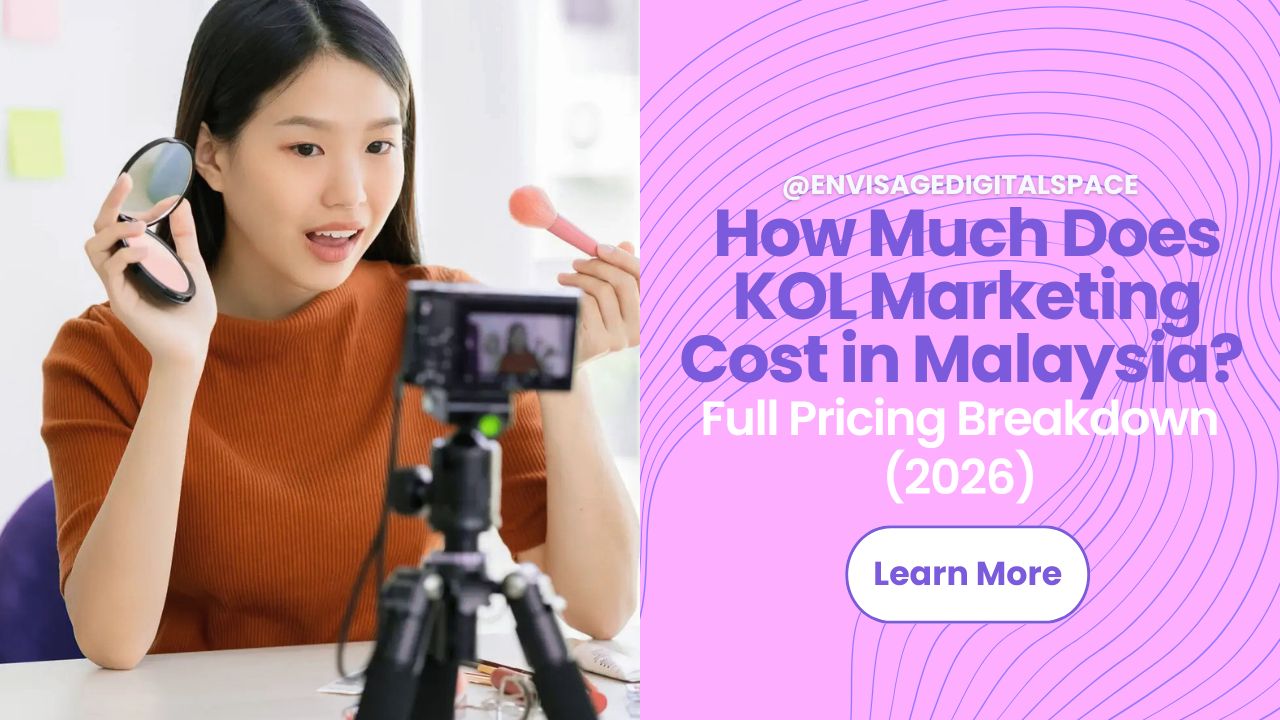
Every Malaysian brand eventually asks the same question: how much does KOL marketing actually cost? There still isn’t a fixed answer. Rates move with creator tier, platform, content format, engagement quality, industry niche, and campaign objectives — a single post can run anywhere from a few hundred ringgit to tens of thousands, depending on who you work with and how the campaign is built.
What has changed is how brands are expected to spend. Rising ad costs and tighter marketing budgets across Southeast Asia mean more brands are shifting spend from paid media into KOL and creator partnerships — but only the brands that understand true pricing (not just headline post fees) are getting a real return. For Malaysian brands in beauty, skincare, fashion, and F&B especially, creator marketing is no longer a nice-to-have; it’s the primary driver of digital sales.
This guide breaks down the real cost of KOL marketing in Malaysia so you can plan smarter, spend better, and maximise returns — tier by tier, platform by platform, hidden cost by hidden cost.
What Affects KOL Marketing Pricing in Malaysia?
Before looking at numbers, it helps to understand why pricing varies so much between two creators with similar follower counts.
KOL marketing rates are shaped by:
- Follower tier — nano, micro, mid-tier, macro, or celebrity
- Engagement rate and audience quality — real, active followers vs. inflated counts
- Platform — TikTok, Instagram, Xiaohongshu (XHS), or YouTube
- Content format — single post, Reel/TikTok video, long-form YouTube integration, or livestream
- Industry niche — beauty, finance, F&B, and other high-competition categories command a premium
- Usage rights — ads whitelisting, reposting permissions, UGC licensing
- Exclusivity agreements — locking a creator out of competitor deals for a period
- Campaign complexity — number of deliverables, revisions, and platforms involved
In short: you’re not paying for a post. You’re paying for audience access, trust, and conversion potential — and each of the factors above moves the price independently of follower count.
🔒 KEPT AS-IS — Do Not Edit
Everything from “Average KOL Marketing Cost in Malaysia (2026 Overview)” through the full tier-by-tier pricing breakdown (Nano, Micro, Mid-Tier, Macro, Celebrity) stays exactly as currently published on the live page. You asked me not to touch pricing, so I left the RM figures, ranges, and the “most brands spend around RM 25,000 per campaign” line untouched — don’t paste anything over that block.
Pricing shifts by platform too — not just by tier.
TikTok KOL Marketing
- Usually 20–50% higher than Instagram for equivalent tier
- Strong for virality and short-form conversion
- Higher production effort (trends, editing, sound syncing) pushes pricing up
Instagram KOL Marketing
- Most stable, predictable pricing model
- Strongest for lifestyle, aspirational, and branding-led campaigns
- Reels and Stories are usually priced separately from feed posts — confirm which format a quote covers
Xiaohongshu (XHS) KOL Marketing
- Commands premium pricing in beauty and skincare niches
- High-trust, high-intent audience — users actively search before buying
- Strong search-driven ROI, especially for Chinese-Malaysian consumer segments
YouTube KOL Marketing
- Highest cost per integration of any platform
- Long-form content has evergreen value — a review can keep driving traffic for years
- Best suited to education-led content and deep product reviews
A practical note for 2026: more brands are running the same creator across two platforms (e.g. a TikTok cutdown of an Instagram Reel, or an XHS note pointing to a TikTok Shop listing). Multi-platform usage should be priced and agreed upfront — it’s rarely included in a single-platform quote by default.
Hidden Costs in KOL Marketing (Most Brands Miss This)
Many brands budget only for the “post fee” and get blindsided later. Real KOL marketing costs usually also include:
- Content usage rights — ads whitelisting so you can run the creator’s content as paid media
- Additional revisions or edits — beyond the 1–2 rounds most creators include by default
- Exclusive category agreements — paying extra to lock a creator out of competitors
- Agency management fees — sourcing, vetting, negotiation, and campaign oversight
- Product seeding and logistics — shipping, courier, and replacement units for damaged/lost stock
- Paid amplification — boosting a KOL’s organic post as an ad
Depending on how the campaign is structured, these can add 20–100% on top of the base post fee. The brands that plan for this upfront negotiate better and avoid surprise invoices mid-campaign; the ones that don’t end up cutting the campaign short right when it starts working.
KOL Marketing ROI: What Malaysian Brands Should Expect
Cost alone isn’t the real metric — ROI is. Well-structured KOL marketing campaigns in Malaysia typically deliver:
- Higher engagement than traditional display or social ads
- Stronger trust-based conversions (audiences buy from creators they already follow)
- Lower cost per acquisition once the creator mix is optimised
- Better long-term brand recall than a one-off paid ad flight
Micro KOLs continue to outperform macro and celebrity creators on conversion-focused campaigns, largely because of stronger audience trust and tighter niche relevance — a micro skincare creator’s followers are more likely to be in-market for skincare than a celebrity’s general audience is.
How to actually measure it: track cost per engagement, cost per click-through, and (where possible) attributed sales via unique promo codes, trackable links, or platform-native shopping tags. A campaign that looks expensive on cost-per-post can still be cheap on cost-per-conversion — and vice versa. Reporting on revenue, not likes, is what separates a KOL campaign that gets renewed from one that quietly gets cut next quarter.
KOL Marketing Trends Shaping Pricing in Malaysia (2026)
A few shifts are changing how brands budget for KOL marketing this year:
- Performance-based and hybrid deals are becoming normal. More creators now accept a lower fixed fee plus a commission or affiliate cut (especially via TikTok Shop), rather than a single flat post fee. This lowers upfront risk for brands but requires tracking infrastructure to work.
- Usage rights are being negotiated upfront, not after the fact. Brands increasingly ask for whitelisting rights as a default line item in the initial quote rather than a costly add-on later.
- Always-on micro-KOL retainers are replacing one-off bursts. Instead of a single campaign, brands are locking in a rotating roster of micro creators on monthly retainers for consistent content velocity and compounding trust.
- XHS is moving from “nice-to-have” to core channel for beauty, skincare, and F&B brands targeting Chinese-Malaysian consumers — pricing on the platform has firmed up accordingly.
- AI-assisted content briefs and reporting are shortening campaign turnaround time, which is starting to put light downward pressure on agency management fees for well-scoped campaigns.
None of this changes the fundamentals — tier, platform, and format still set the baseline price — but it does change how that price gets structured and what brands should be asking for in a quote.
🔒 KEPT AS-IS — Do Not Edit
The “How to Choose the Right Budget for KOL Marketing” section — Startup/Small Brand, Growing Brand, Established Brand, with their RM ranges — stays exactly as currently published. Not touched.
Common Mistakes That Increase KOL Marketing Costs
Paying only for follower count. Follower count alone leads to poor ROI and wasted budget — it says nothing about whether the audience is real or in-market for your product.
Ignoring engagement quality. Fake or inactive audiences reduce conversions no matter how large the follower number looks on paper.
Running one-off campaigns only. A single burst has no compounding effect and little brand recall — the ROI math looks worse than it needs to because there’s no repeat exposure.
Not reusing KOL content for ads. Organic content that performs well is often left to die on the creator’s page instead of being whitelisted and pushed as paid media — a major missed performance opportunity.
No tracking or attribution. Without promo codes, UTM links, or platform tagging, you can’t tell which creators actually drove sales, so you can’t optimise future budget toward what works.
Skipping a written brief and contract. Verbal agreements lead to scope creep — extra revisions, unclear usage rights, missed deadlines — all of which quietly inflate the real cost of a campaign beyond the quoted post fee.
Why Work With a KOL Marketing Agency in Malaysia?
A professional agency helps brands:
- Identify high-performing creators, not just high-follower ones
- Negotiate better rates and clearer usage rights
- Filter out fake or inflated engagement
- Build a campaign strategy around a real objective, not just “get some posts out”
- Track ROI and conversions properly
- Scale campaigns efficiently across platforms and creator tiers
At Envisage Digital Space, we specialise in performance-driven KOL marketing in Malaysia — data-backed creator selection, KOL seeding, content strategy, and multi-platform execution across TikTok, Instagram, and Xiaohongshu.
Conclusion
The cost of KOL marketing in Malaysia varies widely, but the real question was never how much you spend — it’s how strategically you spend it.
In 2026, the brands winning with KOL marketing have moved away from follower-count thinking and toward ROI-driven strategy built on:
- Micro-KOL performance
- Platform-specific execution
- Authentic storytelling
- Content reuse for paid ads
- Data-driven optimisation
Whether your budget is RM 5,000 or RM 500,000, the right strategy — not the size of the spend — determines whether your KOL marketing drives real visibility or actual sales.
If your brand is ready to build a high-ROI KOL marketing strategy in Malaysia, Envisage Digital Space can help you plan, execute, and scale campaigns that deliver measurable business growth.