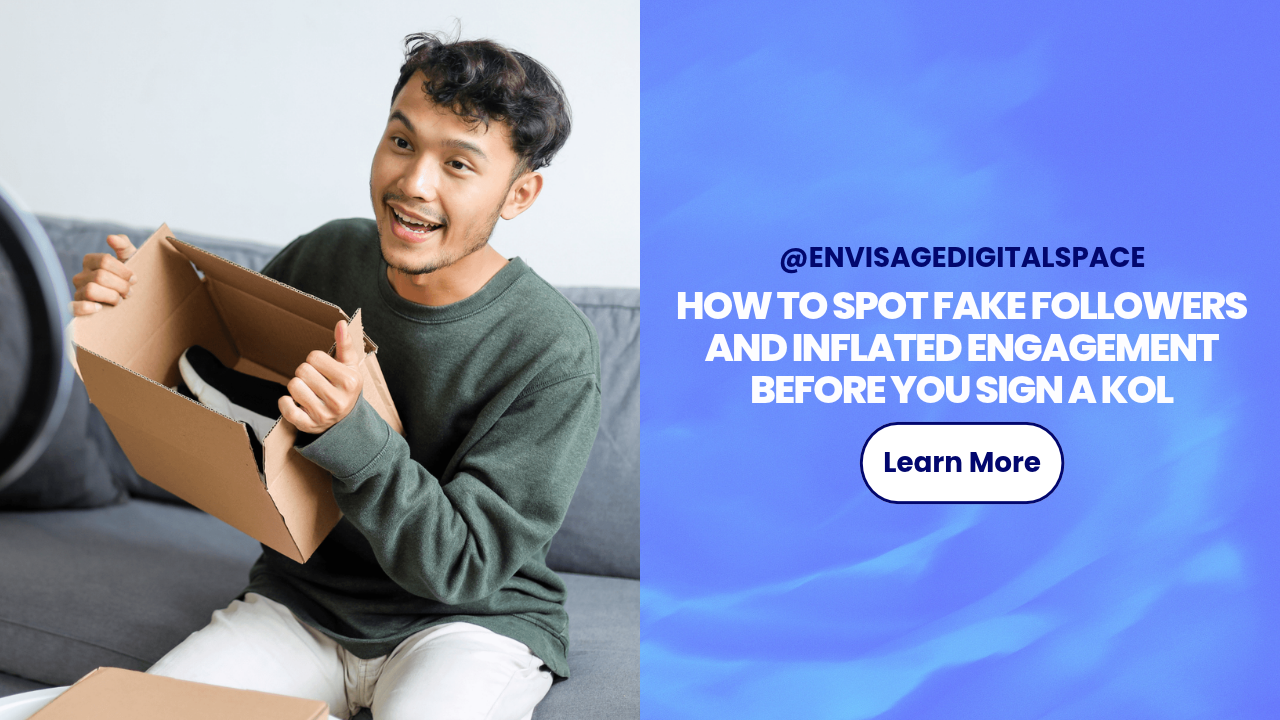
How to Spot Fake Followers and Inflated Engagement Before You Sign a KOL
Influencer marketing has become an important part of how businesses build brand awareness, reach new audiences, and influence purchasing decisions. In Malaysia, brands across industries such as beauty, fashion, food and beverage, and lifestyle are increasingly partnering with Key Opinion Leaders (KOLs) to promote their products and services. However, as the industry continues to grow, one major challenge remains: knowing whether an influencer’s audience and engagement are genuinely valuable.
At first glance, an influencer with 100,000 followers and thousands of likes may seem like an ideal marketing partner. However, these numbers do not always reflect their actual influence. Some accounts rely on purchased followers, automated bots, engagement pods, or artificial interactions to make their profiles appear more popular than they really are.
For businesses investing in KOL Marketing, choosing the wrong influencer can result in wasted budgets, poor campaign performance, and limited returns. An influencer may have impressive statistics but struggle to generate genuine audience interest, meaningful conversations, or actual sales.
This makes influencer verification an essential part of the selection process. Before signing a KOL or committing to a campaign, businesses should understand how to evaluate follower quality, analyse engagement patterns, identify suspicious account activity, and assess whether an influencer’s audience genuinely aligns with their target market.
This guide explains how to spot fake followers and inflated engagement before signing a KOL, helping Malaysian businesses make more informed decisions and protect their marketing investments.
Why Fake Followers and Inflated Engagement Are a Problem in KOL Marketing?
Before examining the warning signs, it is important to understand why fake followers and artificial engagement can negatively affect influencer campaigns.
A large follower count does not necessarily translate into genuine influence. Some influencers purchase followers to make their accounts appear more established, while others participate in engagement groups designed to artificially increase likes and comments.
These practices create misleading performance indicators that can influence brand partnerships and campaign budgets.
For businesses, the consequences can extend beyond financial losses. Campaigns involving influencers with poor audience quality may generate low engagement, attract irrelevant viewers, and fail to produce meaningful conversions.
In addition, partnering with influencers who manipulate their statistics can damage brand credibility, particularly when audiences recognise that the collaboration lacks genuine engagement.
A successful KOL Marketing strategy should therefore prioritise audience authenticity, engagement quality, and relevance rather than relying exclusively on follower numbers.
10 Ways to Spot Fake Followers and Inflated Engagement Before You Sign a KOL
1. Look for Unusual Follower Growth Patterns
One of the first things businesses should examine is an influencer’s follower growth history.
Organic audience growth generally happens gradually as creators publish content, attract new viewers, and build relationships with their communities. While viral content can result in sudden increases, consistently unexplained spikes in follower numbers may indicate suspicious activity.
For example, an influencer who normally gains a few hundred followers each month but suddenly receives thousands within a short period without any viral content or major exposure may require further investigation.
Businesses should examine historical follower trends rather than judging an account based on its current audience size alone.
A sudden increase does not automatically prove that followers were purchased, but it is a useful warning sign that deserves closer attention.
2. Check the Quality of Followers, Not Just the Quantity
An influencer’s follower count is only valuable when those followers represent genuine people who may be interested in the content or products being promoted.
Fake followers often come from suspicious accounts with little activity, generic usernames, no profile pictures, or unusually low numbers of posts.
Some accounts may also follow thousands of profiles while having very few followers themselves. Although these characteristics do not individually confirm that an account is fake, a large concentration of such profiles can indicate poor audience quality.
Businesses should review a sample of an influencer’s followers to understand whether their audience consists of genuine, active users.
For Malaysian brands, it is also important to examine geographical relevance. An influencer may have a substantial following, but if most of their audience is located outside Malaysia, their reach may not support a campaign targeting local consumers.
3. Analyse Engagement Rates Against Follower Counts
Engagement rate is one of the most useful indicators when evaluating an influencer’s performance.
It measures how actively an audience interacts with an influencer’s content through likes, comments, shares, and other platform-specific interactions.
An account with 100,000 followers but only a handful of interactions per post may indicate weak audience interest or an inflated follower count.
However, businesses should avoid relying on a single engagement-rate benchmark because performance varies depending on the platform, account size, content format, industry, and audience behaviour.
A more reliable approach is to compare engagement across several recent posts and assess whether the interactions are consistent with the influencer’s audience size.
For a more accurate evaluation, businesses should also distinguish between likes and deeper engagement activities such as saves, shares, meaningful comments, and link clicks.
A strong KOL Marketing campaign should prioritise genuine audience interaction rather than impressive-looking engagement percentages.
4. Identify Generic or Repetitive Comments
Comments can reveal a great deal about the authenticity of an influencer’s audience.
Genuine followers usually respond to the actual content being shared. Their comments may reference a product, ask questions, share personal experiences, or express opinions related to the post.
In contrast, artificial engagement often consists of repetitive and generic messages such as “Nice!”, “Amazing!”, “Great content!”, or excessive emojis.
While short comments are not necessarily fake, a comment section dominated by identical phrases from unrelated accounts may indicate engagement manipulation.
Businesses should examine whether conversations appear natural and whether commenters demonstrate an actual interest in the influencer’s content.
It is also worth checking whether the same accounts repeatedly appear across multiple posts with similar comments.
Meaningful interactions provide stronger evidence of audience interest than a large number of generic responses.
5. Watch Out for Engagement Pods and Artificial Interaction Groups
Engagement pods are groups of influencers or social media users who agree to interact with one another’s content to artificially increase engagement.
Members may exchange likes, comments, and shares regardless of whether they genuinely enjoy or are interested in the content.
Although engagement pods can make an account appear more active, they do not necessarily represent genuine consumer interest.
One possible warning sign is a recurring group of accounts that consistently interact with an influencer’s posts within a short period, often leaving similar or unrelated comments.
Businesses should examine whether engagement comes from a diverse audience or a relatively small group of accounts that repeatedly interact with one another.
This is particularly important when evaluating influencers for product launches, promotional campaigns, and sales-driven collaborations.
An influencer may have strong visible engagement but still struggle to influence purchasing decisions if their interactions are primarily driven by artificial engagement networks.
6. Compare Engagement Across Different Content Formats
Another effective way to identify suspicious engagement is by comparing how an influencer performs across different content formats.
For example, an influencer may receive thousands of likes on static photographs but consistently generate very low views, comments, or interactions on videos and Reels.
Differences between content formats are normal because each platform distributes content differently. However, extremely inconsistent performance without an obvious explanation may justify further investigation.
Businesses should compare several recent posts rather than relying on one viral upload or sponsored campaign.
They should also examine whether engagement appears proportionate to the content’s reach and whether the influencer maintains consistent audience interest across different topics.
This provides a more complete understanding of the creator’s actual influence and helps businesses avoid selecting KOLs based on isolated performance spikes.
7. Request Audience Demographics and Analytics Screenshots
Publicly visible statistics only provide part of the picture.
Before confirming a collaboration, businesses should request audience analytics directly from the influencer. These insights can help verify whether their followers match the campaign’s intended target market.
Important information includes audience location, age groups, gender distribution, reach, impressions, profile activity, and content performance.
For Malaysian businesses, geographical distribution is particularly important. A local beauty brand, for example, may benefit more from an influencer whose audience is predominantly based in Malaysia than one with a much larger international following.
Brands should also request recent analytics rather than accepting outdated screenshots or statistics from an unrelated campaign.
Whenever possible, ask for screen recordings or live demonstrations of the relevant platform analytics to improve transparency.
A professional KOL should be comfortable providing reasonable performance information when discussing a paid partnership.
8. Examine Sponsored Content Performance and Previous Campaign Results
An influencer’s organic content performance does not always reflect how effectively they promote products or services.
Some creators generate strong engagement through personal content but receive considerably less attention when publishing sponsored posts.
Before signing a KOL, businesses should examine previous brand collaborations to understand how audiences respond to promotional content.
Look at whether sponsored posts receive meaningful comments, whether followers ask questions about the products, and whether the creator communicates promotional messages naturally.
Businesses can also request previous campaign reports containing reach, impressions, link clicks, conversions, and other relevant performance indicators.
However, these figures should be interpreted according to the campaign objectives. A brand awareness campaign and a sales-focused campaign may have very different success measurements.
Evaluating previous collaborations helps businesses determine whether an influencer can translate audience attention into genuine commercial interest.
9. Use Influencer Analytics Tools to Identify Suspicious Activity
Manually reviewing an influencer’s account can reveal several warning signs, but dedicated analytics platforms can provide additional information.
Tools such as Modash, HypeAuditor, and Social Blade offer different features for analysing influencer profiles, audience growth, engagement, and account performance.
Depending on the platform and available data, businesses may be able to identify unusual follower patterns, estimate audience quality, compare engagement trends, and evaluate potential influencer partnerships.
However, these tools should support the evaluation process rather than replace it entirely.
Third-party platforms may use estimates, sampling methods, or incomplete public information. Their authenticity scores should not be treated as definitive proof that an influencer has fake followers.
A more reliable KOL Marketing approach combines analytics tools with manual account reviews, audience demographic checks, and direct communication with the creator.
10. Ask for Clear Deliverables, Performance Expectations, and Reporting Before Signing
The final step is ensuring that the influencer partnership is transparent and measurable.
Before signing a KOL, businesses should establish clear campaign expectations, including content deliverables, publishing schedules, platform requirements, usage rights, campaign duration, and reporting responsibilities.
It is also important to agree on the performance indicators that will be used to evaluate the collaboration.
For example, a brand awareness campaign may prioritise reach and impressions, while a conversion-focused campaign may measure link clicks, enquiries, discount-code usage, and sales.
Businesses should avoid influencers who guarantee unrealistic engagement rates or sales figures without providing a reasonable explanation of how those results will be achieved.
A professional agreement should also clarify how campaign analytics will be shared and when performance reports must be submitted.
Having clear expectations protects both parties while making it easier to evaluate whether the partnership delivers meaningful results.
Common Mistakes Businesses Make When Evaluating KOLs
Even with access to influencer statistics and analytics tools, businesses can still make costly mistakes when selecting marketing partners.
One of the most common mistakes is choosing influencers based entirely on follower count. A creator with 200,000 followers may appear more attractive than someone with 20,000 followers, but the smaller creator could have a more relevant and engaged audience.
Another mistake is assuming that high engagement automatically means strong conversion potential. Likes and comments demonstrate interaction, but they do not necessarily indicate purchasing intent or actual sales.
Some businesses also overlook audience demographics. An influencer may produce excellent content, but if their followers do not match the brand’s target market, the collaboration may struggle to generate meaningful results.
Additionally, companies sometimes rely too heavily on third-party influencer scores without manually reviewing the account. Analytics tools are useful, but they cannot always distinguish between genuine audience behaviour and every form of artificial engagement.
The most effective approach is to evaluate influencers using a combination of quantitative data, qualitative observations, audience relevance, and previous campaign performance.
Why Authenticity Matters in KOL Marketing
As influencer marketing becomes increasingly competitive, authenticity is becoming one of the most important factors influencing campaign performance.
Consumers are more exposed to sponsored content than ever before. As a result, they are increasingly selective about the creators they trust and the recommendations they choose to follow.
Working with influencers who have genuine relationships with their audiences allows brands to communicate their messages more naturally and build stronger consumer confidence.
Authentic engagement also provides businesses with more meaningful campaign insights. Rather than focusing on artificial likes or inflated follower numbers, brands can evaluate genuine conversations, audience interest, website traffic, and purchasing behaviour.
At Envisage Digital Space, we help Malaysian businesses develop performance-driven KOL Marketing strategies through influencer research, creator selection, campaign management, and performance evaluation. By prioritising audience relevance, authentic engagement, and measurable campaign objectives, we help brands identify suitable KOL partnerships that support their marketing goals.
Conclusion
Choosing the right KOL involves much more than looking at follower counts and impressive engagement statistics.
Before signing an influencer, businesses should carefully examine audience quality, follower growth patterns, engagement consistency, comment authenticity, demographic relevance, and previous campaign performance.
Fake followers and inflated engagement can make an influencer appear more influential than they actually are. Without proper verification, businesses risk spending their marketing budgets on partnerships that generate visibility without delivering meaningful results.
A successful KOL Marketing strategy should prioritise genuine influence, audience trust, and measurable business outcomes. By combining manual account reviews, analytics tools, and transparent campaign reporting, Malaysian businesses can make smarter influencer marketing decisions and build partnerships that create long-term value.
Whether you are planning your first influencer collaboration or managing multiple KOL campaigns, Envisage Digital Space can help you develop a customised strategy that connects your brand with the right creators and audiences.
Frequently Asked Questions
How can businesses tell if a KOL has fake followers?
Businesses can identify potential fake followers by examining unusual follower growth, suspicious accounts, generic comments, inconsistent engagement rates, and irrelevant audience demographics. Requesting audience analytics and reviewing several recent posts can also help determine whether an influencer has a genuine and active following.
What is a good engagement rate for KOL Marketing?
There is no universal engagement rate that guarantees successful KOL Marketing. Engagement varies depending on the platform, audience size, industry, content format, and campaign objectives. Businesses should compare an influencer's recent performance with similar creators and prioritise meaningful interactions over a single engagement percentage.
Which tools can help detect fake followers and engagement?
Popular influencer analytics platforms include Modash, HypeAuditor, and Social Blade. These tools offer different features for reviewing follower growth, engagement trends, and audience information. However, their findings should be combined with manual account reviews and verified campaign analytics.
Should businesses choose KOLs with more followers or higher engagement?
Businesses should prioritise audience relevance and genuine engagement rather than follower numbers alone. A smaller influencer with an active, targeted audience may deliver better campaign results than a larger creator whose followers have little interest in the promoted products or services.
What should businesses request before signing a KOL?
Before signing a KOL, businesses should request recent audience demographics, follower growth information, engagement insights, previous sponsored campaign results, and clear deliverables. A written agreement should also outline campaign expectations, payment terms, content usage rights, reporting requirements, and performance indicators.