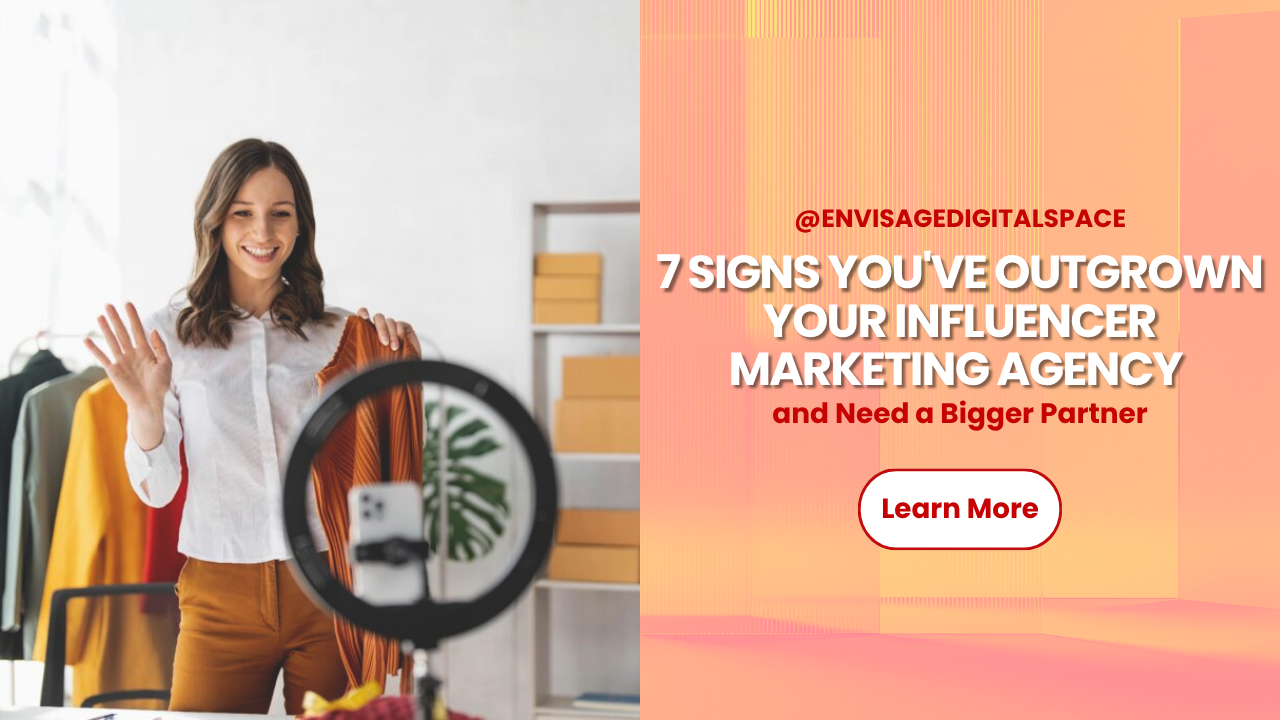
7 Signs You've Outgrown Your Influencer Marketing Agency (and Need a Bigger Partner)
Influencer marketing has become an increasingly important growth strategy for businesses looking to build brand awareness, reach new audiences, and drive sales through trusted creators. From Instagram and TikTok to YouTube and Xiaohongshu, brands are investing in influencer partnerships to connect with consumers in ways that traditional advertising often cannot replicate.
However, as a business grows, its influencer marketing requirements can change significantly. A strategy that worked when a brand was launching its first campaign may no longer be sufficient when the company begins targeting multiple markets, managing dozens of creators, or pursuing more ambitious commercial objectives.
This is where the relationship with an Influencer Marketing Agency becomes particularly important. The right agency should be able to support a brand’s evolving needs, adapt its strategies as campaigns become more complex, and help translate influencer partnerships into measurable business outcomes.
Yet not every agency is equipped to grow alongside its clients. Some agencies excel at managing smaller campaigns but struggle when faced with larger budgets, more creators, tighter timelines, or increasingly sophisticated performance expectations. Others may continue delivering the same services even when the brand requires a more strategic and scalable approach.
Recognising when you have outgrown your current agency is therefore essential. Staying with a partner that can no longer meet your needs may limit campaign performance, create operational bottlenecks, and prevent your business from taking advantage of new opportunities.
This guide explores seven signs that your business may have outgrown its Influencer Marketing Agency, what each sign means, and when upgrading to a larger or more capable partner could help support your next stage of growth.
What Does It Mean to Outgrow Your Influencer Marketing Agency?
Outgrowing an Influencer Marketing Agency does not necessarily mean that the agency is poor at its job. It means that the demands of your business have evolved beyond what the current partnership can comfortably support.
When a brand first begins influencer marketing, its priorities may be relatively straightforward. It might want to collaborate with a handful of relevant creators, increase brand awareness, generate social media engagement, or test whether influencer content resonates with its target audience.
At this stage, a smaller agency may be perfectly suitable. It may provide personalised attention, flexible communication, and a straightforward campaign management process without requiring a large investment.
As the business expands, however, its requirements can become more demanding. The brand may need to coordinate multiple campaigns simultaneously, manage creators across different platforms, introduce paid amplification, measure sales attribution, or expand into new markets.
These changes require more than additional manpower. They may also demand stronger campaign infrastructure, specialised expertise, established creator networks, advanced reporting capabilities, and the ability to coordinate multiple marketing activities efficiently.
A larger Influencer Marketing Agency may be better equipped to provide these capabilities, although size alone does not guarantee better performance. Some specialist agencies offer exceptional expertise in particular industries or platforms that larger, generalist providers may lack.
The key is to determine whether your current agency has the people, processes, technology, and strategic capabilities needed to support your business’s next stage of growth.
Sign 1: Your Campaigns Have Become Too Complex to Manage
One of the clearest signs that you have outgrown your Influencer Marketing Agency is that your campaigns have become significantly more complicated, but your agency’s operating model has not changed.
When a business is smaller, managing five or ten creators for a single campaign may be relatively straightforward. The agency can coordinate communication, collect content drafts, manage approvals, monitor publication dates, and compile performance reports without excessive operational pressure.
However, imagine that your brand begins working with 50 or more creators across TikTok, Instagram, and Xiaohongshu. You may also need to coordinate product shipments, negotiate different creator fees, review multiple content formats, manage usage rights, and align influencer posts with paid advertising campaigns.
The number of moving parts increases quickly.
An agency without sufficient staffing, clear workflows, or suitable campaign management systems may struggle to maintain consistency. Content approvals may be delayed, creator communication may become disorganised, and important campaign details may be overlooked.
These problems can affect more than convenience. Delays may cause brands to miss promotional windows, disrupt product launches, or lose opportunities to amplify high-performing content.
A more capable Influencer Marketing Agency should have established processes for handling large creator rosters, coordinating multiple deliverables, managing campaign timelines, and resolving issues before they affect performance.
For Malaysian brands planning major product launches, seasonal promotions, or campaigns involving creators across different platforms, operational scalability becomes particularly important.
If your current agency repeatedly struggles to manage increasing campaign complexity, it may be time to explore a partner with stronger infrastructure and the capacity to support larger programmes.
Sign 2: Your Agency Keeps Delivering the Same Strategy Despite Your Growth
A strategy that works for a growing business should evolve alongside its objectives.
In the early stages of influencer marketing, your brand may prioritise awareness, reach, and audience engagement. Collaborating with relevant creators can help introduce the business to new consumers and establish initial credibility.
Once your brand has gained recognition, however, its objectives may shift. You might want to generate qualified leads, improve online sales, increase repeat purchases, or expand into new customer segments.
If your Influencer Marketing Agency continues recommending the same types of creators, campaign formats, and deliverables without adjusting its approach, this may indicate a strategic limitation.
For example, a beauty brand that initially relied on awareness-focused TikTok videos may eventually need a more sophisticated combination of educational creators, product demonstrations, affiliate partnerships, customer testimonials, and paid amplification.
Similarly, a Malaysian food and beverage business may progress from inviting local influencers to review its restaurant to developing recurring creator partnerships, promoting new outlet openings, and measuring how campaigns contribute to customer visits and orders.
These different objectives require different approaches to creator selection, content development, campaign structure, and performance measurement.
A capable Influencer Marketing Agency should regularly review your business objectives and explain how its recommendations support your current priorities. It should also identify opportunities to test new strategies when existing approaches stop producing meaningful improvements.
If your agency relies heavily on recycled campaign plans and cannot explain how its strategy should evolve as your brand grows, you may need a partner with stronger strategic planning capabilities.
Sign 3: You Need More Creators Than Your Agency Can Reliably Manage
As brands expand their influencer marketing activities, creator management often becomes one of the biggest operational challenges.
A small campaign may require only a few carefully selected creators. A larger programme may involve dozens or hundreds of influencers, each with different audiences, content styles, rates, schedules, and contractual requirements.
Managing this volume effectively requires more than finding creators with high follower counts.
Brands need to evaluate audience relevance, engagement quality, content suitability, credibility, historical performance, pricing, and potential brand-safety concerns. They must also coordinate outreach, negotiations, briefing, approvals, publication, and reporting.
An Influencer Marketing Agency with limited creator relationships or insufficient account management capacity may struggle to support these requirements consistently.
You may notice that the agency repeatedly recommends the same small group of influencers, takes too long to source suitable creators, or cannot identify enough relevant partners for new campaigns.
This can become particularly restrictive when your brand expands into different Malaysian audience segments or markets. A campaign targeting Malay-speaking consumers may require a different creator mix from one targeting Chinese-speaking audiences or international customers.
A larger agency may offer broader creator networks, dedicated influencer research resources, and established processes for managing large-scale collaborations. However, the quality and relevance of those networks matter more than their size alone.
Your business should also consider whether it needs a broad roster of creators or a smaller number of highly specialised partners. For niche industries, a focused agency with strong relationships in the relevant community may be more valuable than a large agency with a generalist database.
If your current agency cannot reliably source, evaluate, and manage the volume or diversity of creators your business requires, it may be time to consider a partner with greater capacity and more relevant networks.
Sign 4: Your Reporting Cannot Explain the Business Impact of Influencer Marketing
As influencer marketing budgets increase, businesses naturally expect stronger evidence of performance.
In the early stages, basic metrics such as views, likes, comments, reach, and engagement may provide useful information about whether a campaign is attracting attention.
However, these metrics do not necessarily explain whether the campaign is helping the business achieve its commercial objectives.
A campaign may generate impressive views without producing meaningful website traffic, qualified enquiries, product sales, or other desired actions. Conversely, a smaller campaign with a highly relevant audience may deliver stronger commercial results despite receiving less attention.
If your Influencer Marketing Agency consistently provides reports filled with surface-level engagement metrics but cannot explain what those numbers mean for your business, this is an important warning sign.
As your brand grows, you may need more sophisticated measurement approaches. Depending on your objectives, these could include trackable links, campaign-specific landing pages, promotional codes, affiliate tracking, conversion reporting, customer acquisition costs, or comparisons between campaign expenditure and attributable revenue.
Not every influencer campaign should be judged solely on immediate sales. Brand awareness and audience trust can be valuable outcomes, especially when consumers require more time before purchasing. Nevertheless, the agency should establish appropriate objectives and explain how performance will be assessed.
A more capable Influencer Marketing Agency should be able to connect campaign activity to business goals, identify what worked, explain what underperformed, and recommend specific improvements for future campaigns.
For Malaysian businesses investing across multiple platforms, consistent reporting is especially important because each platform may provide different analytics and attribution limitations.
If your agency cannot move beyond vanity metrics or provide useful recommendations based on campaign data, you may need a partner with stronger analytical capabilities and a more commercially focused approach.
Sign 5: Your Agency Lacks the Specialised Services You Now Need
A growing brand rarely relies on influencer marketing in isolation.
As its marketing operations become more sophisticated, it may need to combine creator partnerships with paid social advertising, content production, affiliate marketing, social commerce, community management, and broader digital marketing activities.
For example, a brand may initially pay creators to publish sponsored videos. Once it identifies content that performs well, it may want to obtain the appropriate usage rights and amplify selected videos through paid advertising.
The brand may also want to repurpose creator content across its own social media channels, incorporate customer reviews into product pages, or coordinate influencer activity with a larger product launch.
If your current Influencer Marketing Agency specialises exclusively in basic creator outreach and campaign coordination, it may not have the capabilities to support these additional requirements.
This can lead to fragmented marketing activities. One provider manages influencer relationships, another handles paid advertising, and a third produces creative assets, leaving your internal team responsible for coordinating everything.
In some situations, using several specialist providers is perfectly reasonable. Different agencies may offer deeper expertise in their respective areas. However, the arrangement becomes more difficult when communication gaps, duplicated work, or conflicting strategies begin to affect performance.
A larger Influencer Marketing Agency may offer integrated services or have established partnerships with specialists in paid media, creative production, analytics, and affiliate marketing. This can simplify coordination and help align creator content with wider marketing objectives.
Before switching, determine whether your current agency can expand its services through existing capabilities or trusted partners. If the gap is substantial and likely to persist, finding an agency with the right combination of expertise may be a better long-term investment.
Sign 6: Communication and Turnaround Times Are Slowing Your Campaigns Down
Strong communication is essential to every successful influencer campaign.
Brands need timely updates, clear creator briefs, efficient content approvals, accurate deliverable tracking, and quick responses when unexpected issues arise. As campaigns become larger, these requirements become even more important.
If your agency once responded quickly but now takes days to answer routine questions, regularly misses deadlines, or struggles to provide clear updates, its capacity may no longer match your account’s demands.
These issues can arise when an agency takes on too many clients without expanding its team, relies on unclear approval procedures, or lacks dedicated account management resources.
The consequences can be significant. A delayed creator post may miss a product launch, while slow feedback can force creators to rush revisions or publish content that does not meet the campaign brief.
For Malaysian businesses operating around time-sensitive promotions, festive campaigns, product launches, or major shopping events, these delays can undermine the entire marketing plan.
A larger Influencer Marketing Agency may have dedicated account managers, project coordinators, and established escalation procedures that help keep campaigns organised. However, a bigger team is only useful if it actually improves service quality and accountability.
Before deciding to switch, discuss the problems directly with your current agency. Establish clearer deadlines, communication expectations, approval responsibilities, and escalation processes. A temporary operational problem may be fixable without changing providers.
However, if communication problems continue despite reasonable attempts to resolve them, it may indicate a deeper capacity issue.
At that point, moving to an agency with more reliable account management and stronger operational processes could help your business execute campaigns more efficiently.
Sign 7: Your Business Is Expanding Into New Markets or Larger Campaigns
One of the strongest reasons to consider a larger Influencer Marketing Agency is that your business has entered a new stage of expansion.
A brand that previously focused on one product category, platform, or customer segment may eventually need to reach multiple audiences across different regions.
For Malaysian businesses, this could involve expanding from Penang or Kuala Lumpur into other parts of the country, reaching customers across Malaysia’s different language communities, or entering neighbouring Southeast Asian markets.
Each expansion introduces new considerations. Creator preferences may differ between audiences, content styles may need localisation, and campaign requirements may change according to platform usage, cultural expectations, and purchasing behaviour.
A brand may also need to manage larger budgets, more complex contractual arrangements, additional reporting requirements, or campaigns that run across several markets simultaneously.
An Influencer Marketing Agency that has only managed small, localised campaigns may not possess the experience or infrastructure required to support this level of growth.
A more established partner may provide access to regional creator networks, multilingual campaign support, dedicated account teams, and experience coordinating larger programmes. These capabilities can help brands manage expansion more systematically.
However, geographical reach alone is not enough. A regional agency may still lack the local knowledge needed to communicate effectively with specific Malaysian audiences. Businesses should evaluate actual market experience, creator relationships, language capabilities, and campaign execution rather than relying on claims about international presence.
You should also assess whether the agency can maintain consistency across markets while adapting campaigns to local audiences.
If your expansion plans require resources and expertise that your current provider cannot reasonably supply, upgrading to a more capable partner may help prevent your influencer marketing programme from becoming a bottleneck to growth.
Should You Choose a Bigger Influencer Marketing Agency or a More Specialised One?
Recognising that you have outgrown your current agency does not automatically mean that the largest available provider is the right replacement.
Agency size can influence staffing, operational capacity, and access to resources, but it does not guarantee better strategy, stronger relationships, or superior campaign results.
A larger Influencer Marketing Agency may be suitable for brands that need to manage many creators, coordinate campaigns across several markets, integrate multiple marketing services, or handle substantial campaign volumes.
However, a smaller specialist agency may be a better fit when your business operates in a niche industry, requires highly personalised attention, or prioritises expertise in a particular platform such as TikTok or Xiaohongshu.
For example, a Malaysian beauty brand targeting Chinese-speaking consumers may benefit more from an agency with deep Xiaohongshu knowledge and relevant creator relationships than from a much larger provider with limited experience on the platform.
Similarly, a business running a small number of high-value campaigns may not need a large agency’s full operational infrastructure.
When evaluating potential partners, focus on the capabilities that address your specific challenges. Ask how the agency manages creator sourcing, campaign execution, reporting, communication, content rights, and performance optimisation.
You should also establish who will manage your account. An agency may have an impressive senior leadership team, but your daily experience will depend heavily on the people assigned to your campaigns.
The goal is not simply to move to a bigger agency. It is to find an Influencer Marketing Agency that can support your next stage of growth without introducing unnecessary costs, complexity, or bureaucracy.
How to Transition to a New Influencer Marketing Agency Without Disrupting Campaigns
Changing agencies can create uncertainty, especially when your business has ongoing campaigns, established creator relationships, or important product launches.
A successful transition requires careful planning to ensure that campaign information, creator agreements, performance data, and upcoming deliverables are transferred properly.
Begin by reviewing your existing contract. Understand the notice period, termination requirements, outstanding payments, ownership of campaign materials, and any restrictions affecting creator relationships or content usage.
Next, document your current influencer marketing activities. This should include campaign objectives, creator lists, contact details where contractually shareable, agreed deliverables, publication schedules, performance reports, payment status, and relevant content usage rights.
You should also identify which campaigns need to be completed before the transition and which can be handed over to the new agency.
Where possible, avoid changing providers during a critical campaign period unless the current arrangement presents a serious operational or commercial problem. A poorly timed transition may create more disruption than the existing issues.
When evaluating a replacement, provide a clear explanation of why the current partnership is no longer sufficient. This allows prospective agencies to demonstrate how they would address the specific gaps rather than simply presenting a generic service proposal.
A capable Influencer Marketing Agency should have a structured onboarding process that covers business objectives, audience research, brand guidelines, campaign history, reporting requirements, communication procedures, and performance expectations.
It is also important to establish measurable goals for the new partnership. These may include improving campaign turnaround times, expanding creator coverage, increasing qualified traffic, improving conversion tracking, or managing a larger volume of campaigns without compromising quality.
At Envisage Digital Space, we understand that influencer marketing requirements evolve as brands grow. A clear strategy, relevant creator partnerships, and structured campaign management can help businesses build a more scalable approach to influencer marketing. The right partnership should support your commercial objectives while adapting to the changing needs of your brand.
How to Evaluate Whether Your New Agency Is Delivering Better Results
Switching to a larger or more capable agency should solve identifiable problems, not simply create the appearance of progress.
Before beginning the new partnership, establish a baseline using your existing campaign performance, operational processes, and business objectives. This provides a point of comparison for evaluating whether the change is producing meaningful improvements.
For example, if your previous agency struggled to manage creator volume, measure whether the new partner can coordinate more creators while maintaining content quality and meeting deadlines. If reporting was a weakness, assess whether the new agency provides clearer analysis and more actionable recommendations.
If your main objective is commercial growth, define appropriate performance indicators such as qualified leads, attributable sales, cost per acquisition, or revenue generated through trackable campaign links. Where attribution is incomplete, acknowledge those limitations rather than assuming every sale resulted from influencer activity.
You should also consider the quality of the working relationship. Improved communication, clearer accountability, and more reliable campaign execution can create substantial value even before long-term commercial results become visible.
However, influencer marketing outcomes depend on multiple factors, including the product, pricing, audience relevance, creative quality, market conditions, and campaign execution. A new agency cannot guarantee success simply because it has more employees or a larger creator network.
Review performance regularly and allow sufficient time for campaigns to generate meaningful evidence. Compare results against realistic objectives, identify what has improved, and adjust the strategy when necessary.
The ultimate purpose of upgrading your agency is to gain the capabilities your business needs to grow. If the new partnership consistently delivers stronger execution, better insights, and more effective alignment with your objectives, the transition may prove worthwhile.
Conclusion
Outgrowing your Influencer Marketing Agency is a natural part of business growth. As your brand expands, your campaigns may become more complex, your creator requirements may increase, and your expectations for reporting, strategic planning, and commercial performance may evolve.
The seven signs explored in this guide highlight common reasons a business may need a more capable partner: increasingly complex campaigns, repetitive strategies, limited creator capacity, inadequate reporting, missing specialist services, slower communication, and expansion into new markets.
However, recognising these signs does not mean that switching agencies is always the immediate answer. Some issues can be resolved through clearer expectations, improved workflows, or an expanded service arrangement with your existing provider.
The important question is whether your current agency has the expertise, resources, and operational capacity to support your next stage of growth.
A larger Influencer Marketing Agency may be the right choice if your business needs greater scalability, broader creator networks, integrated marketing services, or more sophisticated campaign management. In other cases, a specialist agency with deep industry or platform knowledge may provide a better fit.
At Envisage Digital Space, we help brands approach influencer marketing with a focus on relevant creator partnerships, strategic campaign planning, and measurable business objectives. If your current agency can no longer keep pace with your ambitions, it may be time to reassess your options and find a partner that can support your next stage of growth. Contact us today to explore how we can help strengthen your influencer marketing strategy.
Frequently Asked Questions
How do I know when to change my Influencer Marketing Agency?
You should consider changing your Influencer Marketing Agency when it consistently struggles to manage campaign complexity, source suitable creators, provide meaningful performance insights, meet deadlines, or support your evolving business objectives. Before switching, discuss the issues and determine whether they can be resolved through clearer expectations or an expanded service arrangement.
Is a bigger Influencer Marketing Agency always better?
No. A larger agency may offer more resources, broader creator networks, and greater operational capacity, but size does not guarantee better results. A smaller specialist agency may be more suitable if your brand needs deep industry knowledge, platform expertise, or personalised attention. Choose a partner based on your campaign requirements and growth objectives rather than size alone.
What should I look for when upgrading to a larger Influencer Marketing Agency?
Evaluate the agency's experience with campaigns of similar scale, creator network quality, account management structure, reporting capabilities, specialist services, and understanding of your target market. You should also clarify pricing, deliverables, communication processes, content usage rights, and how campaign performance will be measured.
How much does it cost to hire a larger Influencer Marketing Agency in Malaysia?
Costs vary according to campaign size, the number of creators, creator fees, content production requirements, platform coverage, paid advertising, and the agency's service scope. A larger campaign may require a higher budget, but businesses should compare the full cost of services and expected deliverables rather than assuming that a larger agency is automatically more expensive or cost-effective.
Can I switch Influencer Marketing Agencies while campaigns are ongoing?
Yes, but the transition requires careful planning. Review your existing contract, confirm notice periods, document creator agreements and outstanding deliverables, and clarify ownership and usage rights for campaign materials. Where possible, coordinate the handover around campaign milestones to reduce disruption and ensure that the new agency has the information needed to continue the work effectively.